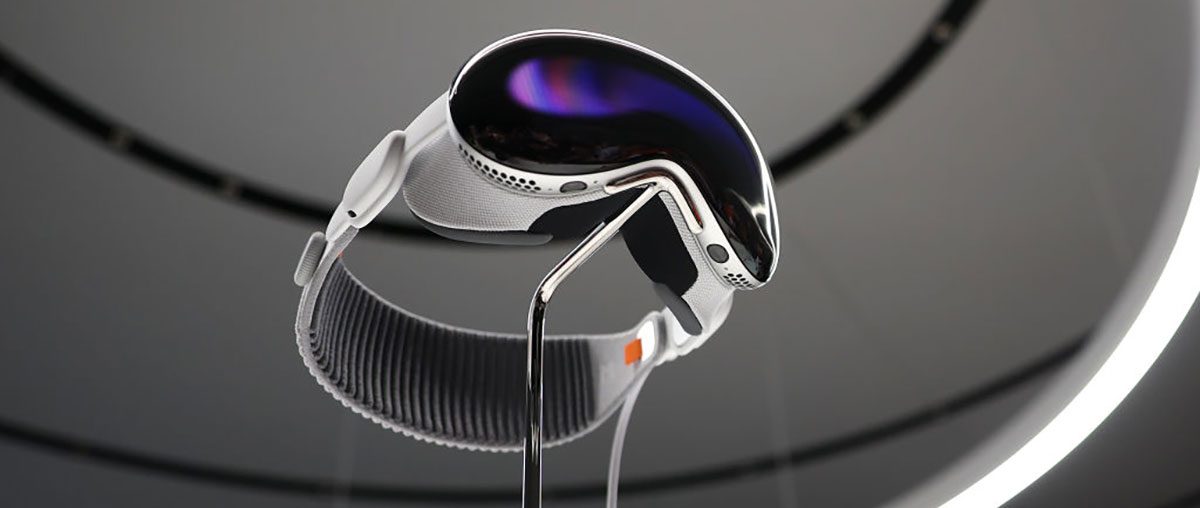
Apple isn’t precisely identified for being the pioneer of recent know-how just lately. Whether or not it is folding smartphones, elaborate sound know-how or hidden cameras, Apple isn’t first out of the gate.
Commercial
As a substitute, it waits. A number of years go by, know-how advances and as soon as its opponents have launched a couple of variations of one thing, Apple swoops in with their first iteration. Refined, highly effective, trendy and at all times extraordinarily costly.
Years on from the preliminary increase of digital actuality, Apple has lastly performed its card, saying its first VR headset. It could be late to the get together, however Apple has made its regular transfer, with its first-ever step into digital actuality being the perfect mannequin we’ve seen but.
So, what’s so good about Apple’s first enterprise into the world of the digital? We spoke to David Reid, professor of AI and spatial computing at Liverpool Hope College to seek out out.
Mixing realities
© Justin Sullivan
Not like some earlier makes an attempt at a usable digital actuality headset, Apple’s Imaginative and prescient Po system utilises a blended actuality format. Which means, as a substitute of blacking out the world round you, the headset mixes the digital with the actual world.
Put the headset on and you could possibly work together with a digital floating monitor above your desk, play video games in your front room or basically make the actual world just a little bit extra enjoyable.
“The large promoting level right here is that Apple is attempting to increase what we imply by the metaverse. The place Meta relies in digital actuality, Apple is taking a look at augmented actuality, placing these digital components into the world round you.”, says Reid.
“There’s a concept often known as spatial computing. It’s the concept a machine can retain and manipulate referents to actual objects on the planet. That’s what Apple is doing right here and doing so believably.”
This doesn’t imply that the headset is incapable of utilising digital actuality. With a toggle of a swap on the aspect of the headset, customers can alter how a lot of the world round them is blocked out.
Capable of entry each digital and blended realities, Apple is trying to supply the perfect of each worlds. Whereas they aren’t the primary to do that, they’re the primary to do it with this a lot processing energy.
Energy on prime of energy
The place Apple actually stands out from the group is contained in the headset. Apple makes use of two separate chipsets with the Imaginative and prescient Professional, one for processing graphics, imaginative and prescient algorithms and operating the software program, and a second absolutely centered on processing enter from the cameras, sensors, and microphones.
This twin setup permits pictures to be displayed lag-free in 12 milliseconds. In concept, this leads to a far smoother digital actuality expertise, freed from jolty actions taking you out of the expertise.
Extra like this
“Primarily, that is extra highly effective than a Macbook Professional. It’s principally a pc strapped to your face. I’m positive this may imply a lot of new purposes, and new methods to not simply play video games, however to work, socialise and even only for searching the web,” says Reid.
© Bloomberg
“You’ll be capable of do issues as creatives and professionals you can’t do on conventual computer systems. Due to the value, it can solely be early adopters at first, however because it will get cheaper and extra available, Apple can be main the best way for VR.
Together with the highly effective processors, Apple has launched quite a few different distinctive options. Controllers are gone and as a substitute, Apple utilises highly effective eye trackers that may exactly decide what you’re looking at.
There are 12 cameras and 5 sensors within the system. These monitor hand gestures and map the exterior atmosphere. Two of those cameras transmit roughly a billion pixels per second to the show, depicting the actual world across the consumer.
As a further degree of immersion, Apple has enter audio system on both aspect of the headset. These audio system function dual-driver audio pods positioned immediately subsequent to the ears. They analyse a room’s acoustic properties, adapting the sound to match the house.
“The factor has over a dozen cameras and an advanced monitoring system. That requires an enormous quantity of processing energy, however Apple has managed to implement that. That may be spectacular sufficient however Apple then added in a complete host of different high-end options on prime,” says Reid.
The movement illness downside
All through all variations of digital actuality, there may be one main downside that has plagued the design – movement illness. Unsurprisingly, two tiny screens inches out of your eyes displaying quickly transferring footage has the tendency to make individuals really feel a bit sick.
So, has Apple sorted this…? Sort of. “It’s higher, but it surely nonetheless isn’t splendid. The primary downside with VR movement illness is Vergence-accommodation battle (VAC).”
VAC is, in essence, a problem that we expertise when the mind receives mismatching cues between the gap of a digital 3D object and the focusing distance required for the eyes to concentrate on that object.
This continuously happens with digital actuality because of the nearness of the show. At the moment, there isn’t any repair for this with digital actuality, however quite a few corporations (together with Apple) are engaged on know-how that would repair this.
“With Apple, they’ve tried to scale back the movement illness as a lot as potential. By decreasing lag and delay, and utilising high-quality shows, Apple has made a headset that’s nonetheless greatest at school for movement illness,” says Reid.
Commercial
Movement illness remains to be going to happen, and for some, that’s at all times going to be an issue with digital actuality. Nonetheless, Apple appears forward of the sport at minimalising the issue as a lot as potential.


