‘Triumph of the Spirit’ is not only a recounting of World Warfare II, however seems to be to ‘uplift’ the viewer, certainly one of its creators says
Solely Pope Francis had ever walked via Auschwitz alone earlier than. Not even Steven Spielberg – on the peak of his powers within the mid-Nineties – was allowed to movie contained in the Nazi focus camp for his movie “Schindler’s Checklist.”
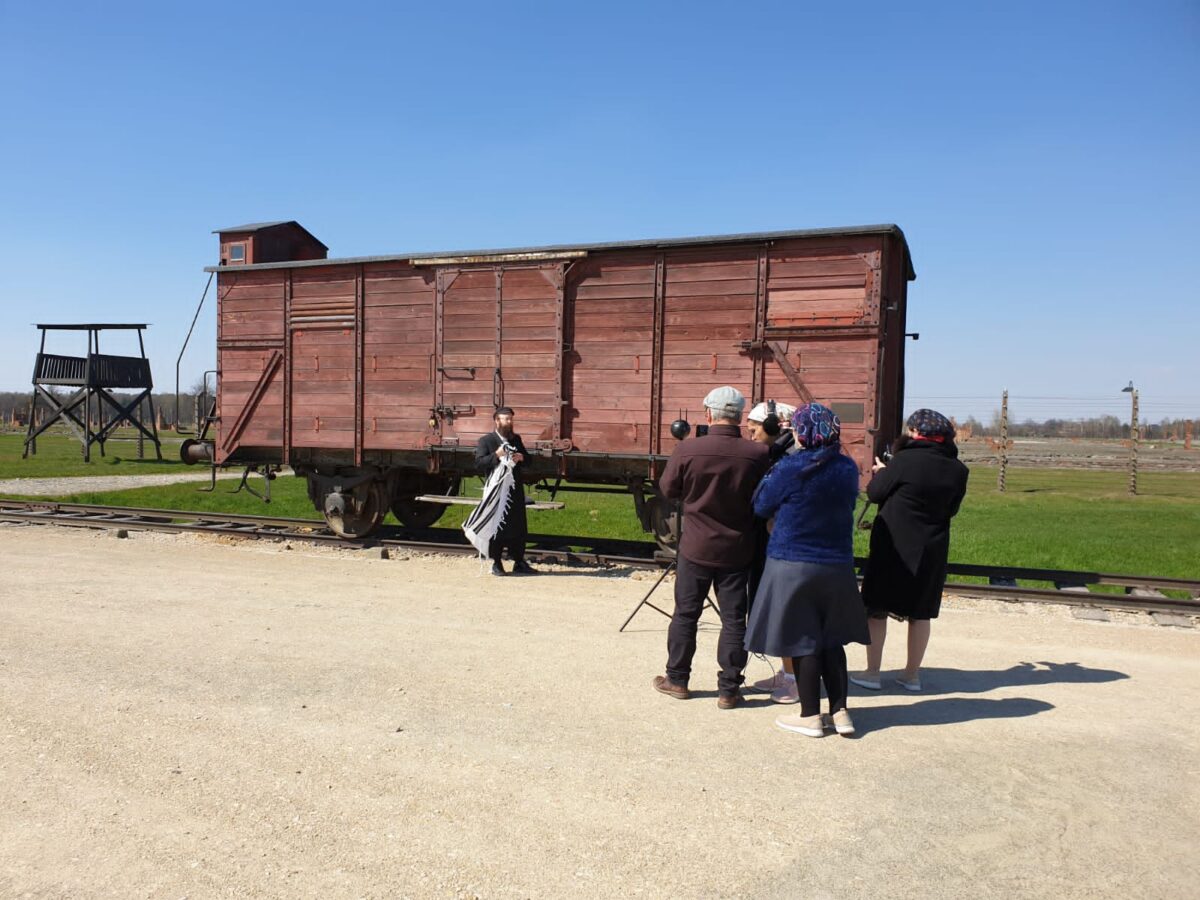
However that’s what Haredi filmmakers Miriam Cohen, Chani Kopilowitz and Yuti Neiman wished to do – to movie a 50-minute, 360-degree, digital actuality guided tour of Auschwitz-Birkenau. Roughly 4 years in the past, they realized about VR-filmmaking and have become satisfied that this was the best way to coach individuals – “Jews normally and ‘believing Jews’ particularly,” as Cohen phrased it – in regards to the Holocaust. (They’re now working to adapt the movie to non-Jewish audiences as nicely.)
The movie is entitled “Triumph of the Spirit.” It has already been seen by upwards of 90,000 individuals, both in privately organized viewings of as much as 200 individuals or within the basement of Jerusalem’s Mamilla Mall, the place anybody over the age of 15 should buy a ticket to see it. It’s out there in Hebrew and English.
Cohen grew up within the Haredi neighborhood of the Hashmona’im settlement between Jerusalem and Tel Aviv, the place she enviously watched her non-Haredi friends touring to Poland with their excessive colleges. “Everybody goes on a visit to Poland. It’s not even a query, and when the youngsters got here again, I bear in mind seeing them after they went via such a big expertise, and I simply felt that I missed one thing critical,” Cohen advised eJewishPhilanthropy.
Whereas most secular and national-religious excessive colleges in Israel take college students to Poland to be taught in regards to the Holocaust, this observe is nearly unparalleled in Haredi colleges for each logistical and ideological causes. Cohen mentioned she and her companions felt that simply because Haredi college students and Haredi Jews normally wouldn’t journey to Poland, shouldn’t imply that they will’t be taught in regards to the Holocaust in an immersive manner.
“Everybody advised us it was a mistake. They mentioned, ‘Nobody goes to take a seat there with these glasses on their heads for an hour. You may’t make a full-length documentary with VR. VR is for gaming, purposes, avatars. Possibly you must make a “Catch the Nazi” app,’” Cohen advised eJP. “Once we heard that, we realized that nobody understood our imaginative and prescient.”
Going it alone, they realized to make use of the VR tools and began trying into what it could take to movie inside Auschwitz. They shortly realized that this is able to be the toughest half. This was in early 2020, simply in the beginning of the COVID-19 pandemic when air journey was restricted and Auschwitz-Birkenau was closed to guests. They reached out to Yad Vashem, the Polish Embassy in Israel and different Holocaust memorial organizations for assist. “All of them advised us Auschwitz-Birkenau is such a giant paperwork… Steven Spielberg didn’t get permission – who’re you?” Cohen mentioned.
“As a believing individual, when all of the doorways appeared to shut in our faces, the one factor I may do is to lookup and say, ‘Creator of the World, assist me!’ and pray for it,” she mentioned.
They finally acquired the cellphone variety of a girl from the Auschwitz-Birkenau Memorial and Museum who organized a particular assembly of the establishment’s board to contemplate their request. On the finish of the assembly, 4 and a half hours later, the girl known as Cohen. “She mentioned, ‘I simply acquired out of the assembly. I fought for you. You may come subsequent Monday. The museum will likely be open just for you for 3 days.’ Loopy! It was a miracle,” she mentioned.
“All through this venture, I’ve at all times mentioned that I’ve six million souls pushing me ahead,” Cohen added.
Attending to Poland in time proved to be its personal wrestle. This was in Might 2020, with the pandemic in full swing, so a number of flights that they’d booked to Poland had been canceled, however they finally made it, the three Haredi filmmakers and the information for the video, Rabbi Yisrael Goldwasser, a member of the Ger Hasidic neighborhood, the grandson of 4 Holocaust survivors and a Holocaust researcher.
It was Cohen’s first time in Auschwitz, realizing the dream she’d had since highschool. “I didn’t know that once I would go, I might be taking tens of 1000’s of individuals with me,” she mentioned.
The movie has largely been out there solely in Israel, however earlier this yr, it was additionally proven in the UK, the place it was screened on the Home of Lords. Although the movie was made by and for non secular Jews, Cohen mentioned they’ve proven it to all kinds of Jews, in addition to teams of non-Jews, who’ve praised it.
Cohen mentioned she has acquired a number of requests to indicate the movie in North America as nicely, however that they require funding to take action. “Moving into the U.S. takes some huge cash,” she mentioned.
Along with growing the idea of the VR movie by themselves, Cohen and Kopilowitz additionally funded the venture nearly solely on their very own, placing of their financial savings and getting loans from family and friends. (The Maimonides Fund, whose brand seems at first of the movie, helped fund the screening within the U.Okay., Cohen mentioned.)
“Individuals suppose that the Holocaust is one thing that there’s at all times funding for, however what occurred was we acquired permission to movie [in Auschwitz] so all of a sudden that we simply needed to take loans from cousins, mates, dad and mom and household. After which as soon as we did it, we simply wished to get the film out, so we took extra loans,” she mentioned. “Now we wish to return that cash.”
The documentary begins earlier than the Holocaust, exploring the non secular Jewish historical past of Krakow, Poland, with a tour of the town’s Jewish quarter and its Outdated and New Synagogues. Earlier than coming into Auschwitz, Goldwasser tells the viewers that they don’t seem to be “vacationers” however are as an alternative “mourners,” paying their respects to the victims of the Nazis.
The documentary is just not a value-neutral, factual recounting of the occasions of the Holocaust. Cohen mentioned the film is geared towards non secular Jews, considers their sensitivities and wishes, and has a hopeful non secular message. “It’s not graphic in any respect. There aren’t any tough photographs,” she mentioned.
Cohen, who was pregnant after they had been filming, mentioned that being in Auschwitz was extremely tough for them. “It shattered us to items. We didn’t suppose that we’d have the ability to work. We may barely stand. What gave us the power to proceed was the will to inform this story in a manner that offers power, a manner that offers hope,” she mentioned.
Goldwasser fills the 50 minutes of the movie with anecdotes and tales, typically assisted by survivors’ personal testimonies, which might be seen on screens that pop up contained in the video. All of those tales have a hopeful, if not pleased, ending and sometimes a spiritual bent. The boy who plans to kill himself by throwing himself onto an electrical fence however stops when he hears different Auschwitz inmates singing the Hanukkah track “Maoz Tzur”; the person who was killed for working again to a practice automobile to retrieve his tallit and tefillin, whose son survived and bought such a practice automobile for the Auschwitz-Birkenau Memorial and Museum, placing inside a tallit and tefillin in reminiscence of his father; the girl who was meant to endure a surgical procedure that will make her infertile as a part of an experiment by Nazi scientist Josef Mengele however who was secretly spared by a Jewish physician who solely pretended to carry out the operation.
“There aren’t any tales that don’t have a light-weight on the finish of the tunnel. Our purpose was to not destroy the viewer – the alternative. Our purpose was to inform the story, with all of the ache in it, however in a manner that’s uplifting and stuffed with spirit. That’s why we known as it, ‘Triumph of the Spirit,’” she mentioned.


