AMA Replace covers a variety of well being care subjects affecting the lives of physicians, residents, medical college students and sufferers. From personal observe and well being system leaders to scientists and public well being officers, hear from the specialists in medication on COVID-19, medical training, advocacy points, burnout, vaccines and extra.
Featured subject and audio system Featured subject and audio system
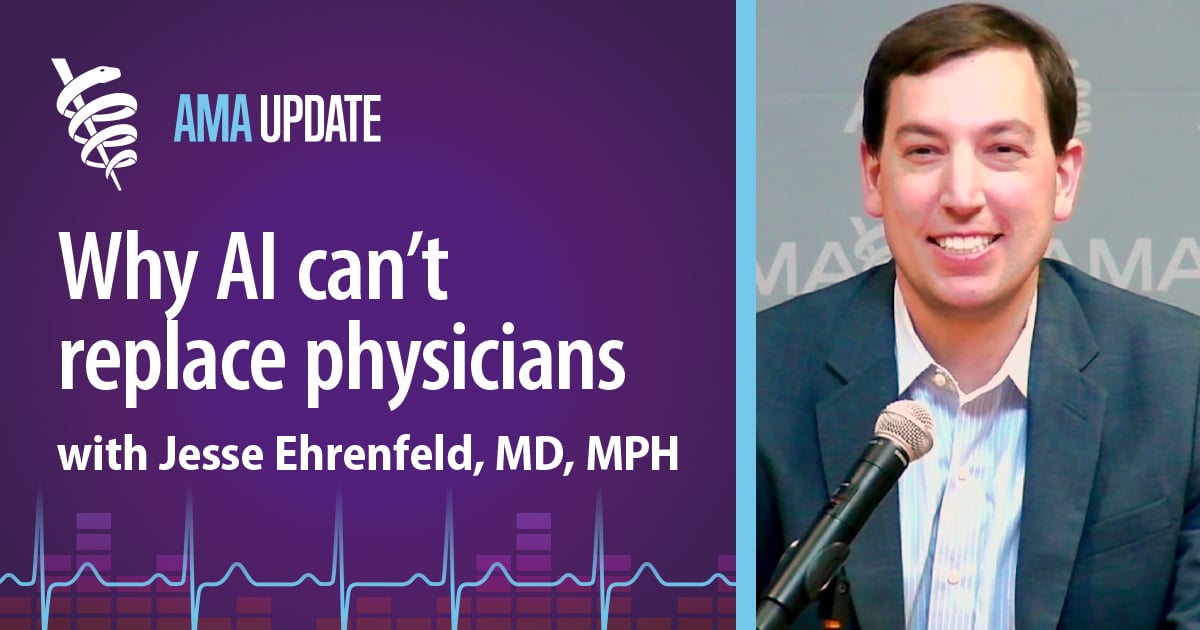
Using generative AI, like ChatGPT, in medication has the potential to unburden physicians and assist restore the patient-physician relationship. Nevertheless, regulatory uncertainty and legal responsibility issues are limitations to adoption. American Medical Affiliation President Jesse Ehrenfeld, MD, MPH, joins to debate the various methods generative AI will change well being care. AMA Chief Expertise Officer Todd Unger hosts.
The AMA is your highly effective ally in affected person care. Be a part of now.
Speaker
Jesse Ehrenfeld, MD, MPH, president, AMA
AMA Restoration Plan for America’s Physicians After combating for physicians throughout the pandemic, the AMA is taking over the following extraordinary problem: Renewing the nation’s dedication to physicians. Let’s Get Began
Transcript Transcript
Unger: Hey and welcome to the AMA Replace video and podcast earlier this 12 months, we took a broad take a look at the affect that generative AI like ChatGPT may need on well being care. And as we speak we will dig just a little bit deeper and discover the way it may change how physicians observe and care for his or her sufferers. With me as we speak to debate that’s AMA President Dr. Jesse Ehrenfeld in Milwaukee, Wisconsin. I am Todd Unger, AMA’s chief expertise officer in Chicago. Welcome again, Dr. Ehrenfeld.
Dr. Ehrenfeld: Yeah, it is good to speak to you, Todd. Thanks for having me.
Unger: Properly, a number of the dialog round generative AI has targeted on two issues—primary, the power to doubtlessly diagnose sufferers, and second, to assist alleviate a number of the executive burdens that physicians face. I would like to begin by getting your ideas on AI’s diagnostic capabilities. What’s presently within the playing cards for it to have the ability to do and never do?
Dr. Ehrenfeld: Properly, it is an awesome place to begin. Even essentially the most superior algorithms in AI-enabled instruments nonetheless cannot diagnose and deal with illnesses. And that is actually the improper strategy.
The probabilistic algorithms, they’re simply too slender. They cannot substitute for the judgment, the nuance or the thought {that a} clinician brings. And so I believe there’s a number of alternative to consider these instruments as a copilot however not an autopilot notably within the diagnostic realm.
And that is why the FDA’s forthcoming regulatory framework for AI-enabled units is proposing to be way more stringent on AI instruments that make a prognosis or suggest a remedy, particularly if it is an algorithm that continues to adapt or study over time, these so-called steady studying techniques.
Now, algorithms are nice for fixing a textbook affected person or a really slender medical query. And that is why there was a pleasant description within the literature how ChatGPT might so-called cross the USMLE. The USMLE is filled with such instances. I do know. I write them.
However sufferers, they don’t seem to be a standardized query stem. They’re people with ideas, with feelings, with advanced medical, social, psychiatric backgrounds. And I am going to let you know, they hardly ever observe the textbooks. And it is that sophisticated individual that requires the patient-physician relationship. And it is that sacred bond that emphasizes the person.
Now, a number of my sufferers, they could are available in for related surgical procedures, related anesthesia care. I am an anesthesiologist. However most of my sufferers have completely different targets. And a profitable consequence is commonly not the identical for any explicit affected person. So even when a pc might analyze all of this, the algorithm remains to be going to offer you a generic reply.
Unger: What an awesome reply to level out the complexities that we’re going through proper now. Let’s flip to the opposite a part of that from the place we began, which is the executive burdens which are simply so important on physicians. The place do you see AI enjoying a task there?
Dr. Ehrenfeld: Properly, there’s an enormous alternative. And we all know that primarily based on our survey information about 20% of U.S.-based practices are already utilizing AI. However that is the place they’re utilizing it. They’re utilizing it to unburden these administrative issues. They’re utilizing it for provide chain administration, scheduling, optimization.
Now, primarily based on our technical and regulatory perspective, the AMA strongly feels that AI must be leveraged first to unburden physicians. In different phrases, use the AI to detether us from our computer systems, assist carry us again to our sufferers and restore the patient-physician relationship.
This unburdening function is one thing that AI applied sciences, machine studying, automation, have been enjoying in medication for years now. Practices which have embraced these applied sciences have seen some actually spectacular outcomes.
And unburdening physicians is just not solely how AI can finest contribute, nevertheless it’s additionally one of many locations the place we all know that there could be a huge distinction when it comes to the power of those instruments to help practices the place they want essentially the most assist. 1-in-2 physicians now say that they are burnt out. 1-in-5 physicians say that they are planning to go away the observe of medication within the subsequent two years.
Given all that, now we have to have new options. We want new instruments that make the most of the most recent generations of those AI fashions that may assist us with our notes, assist us with paperwork, assist us with these different administrative necessities.
Unger: What an awesome precedence to make use of AI to unburden physicians as you talked about it. And once more, again to the complexities that you simply laid out, regardless of how generative AI is used to finally help physicians, there may be one factor that’s sure, that it will definitely goes to make a mistake. And when it does, who’s going to be responsible for a mistake like that?
Dr. Ehrenfeld: It is a actually essential difficulty. And never all digital well being improvements dwell as much as their guarantees. And if I lose a affected person due to an algorithm, that’s the inherent query of legal responsibility for physicians. And the place the legal responsibility is positioned, how it’s managed has a specific significance in well being care.
Physicians and the well being care business are more likely to be on the hook when issues go improper way more so for me than the developer or the innovator. There’s an energetic present federal proposal that might maintain physicians solely responsible for the hurt ensuing from an algorithm if I depend on the algorithm in my medical determination making.
We do not assume that is the proper strategy. We predict that the legal responsibility should be positioned with the people who find themselves finest positioned to mitigate the hurt. And that’s seemingly going to be the developer, the implementer, whoever buys this stuff, typically not the tip person, the clinician.
Unger: What an enormous level. As a result of if physicians usually tend to be held accountable for errors like that, I think about that is going to have a huge impact on how enthusiastic or hesitant a doctor may be to make use of a expertise like this of their observe.
Dr. Ehrenfeld: It will kill the market. And legal responsibility is a possible barrier to the uptake of AI. And if I can not depend on the output of a system as an enter into my determination making as a result of I am fearful about legal responsibility issues, then justifying use in my observe goes to be actually, actually troublesome. So uncertainty throughout the regulatory system makes these questions of legal responsibility a lot, way more advanced than you see instantly while you take a look at the floor.
We agree with the FDA and others that the prevailing regulatory paradigm for {hardware} medical units simply would not work. It is not properly suited to appropriately regulate AI-based units, software program, software program as a medical system. So we help the FDA’s efforts to discover a brand new strategy to control these instruments. And we’re actually trying to associate with the FDA to be sure that no matter we do, we solely have protected and efficient merchandise within the market.
Unger: Now, we have talked loads about how physicians may really feel cautious or not about counting on generative AI. Do you could have any sense for a way sufferers are feeling about this expertise?
Dr. Ehrenfeld: There’s a number of discomfort round using these instruments amongst People with the concept of AI being utilized in their very own well being care. There was a 2023 Pew Analysis Heart ballot. 60% of People would really feel uncomfortable if their very own well being care supplier relied on AI to do issues like diagnose illness or suggest a remedy.
So there must be extra carried out by means of regulation and with the developer neighborhood to strengthen belief in these instruments. Belief is key to what we do in well being care. It’s elementary to the patient-physician relationship. And preserving sufferers belief in an more and more digital world is completely essential.
There are additionally issues concerning the use or misuse of well being information. And people lengthen to the AI area. We’ve got a survey from 2021, an AMA survey, confirmed that 94% of sufferers need robust legal guidelines to manipulate using their well being information. So when you consider all of this stuff collectively, it is not a slam dunk. We have to be sure that we protect the belief of our sufferers and shield the privateness of their well being information.
Unger: Completely. So given the complexities that we have talked about and the promise of this sort of expertise, what recommendation do you could have for physicians in phrases about of how they’ll play a task within the sort of go-forward right here to assist AI attain its potential in medication?
Dr. Ehrenfeld: Properly, it is an thrilling time. We’re seeing all of this speedy improvement, a number of hype, a number of chatter, a number of experimentation occurring.
However throughout this explicit interval in historical past when AI instruments, laws are quickly evolving, it’s extra essential than ever for physicians to make their voices heard, particularly on datas like—on points like information accuracy, well being fairness, privateness, legal responsibility. We all know that these algorithms may also be flawed. They are often primarily based off of defective information or research which are ultimately overturned.
The period of big-data personalised medication remains to be in its infancy with essentially the most giant information units consisting of solely primary demographics, info, ICD codes. We’re simply now seeing the significance of accumulating information on the social determinants of well being.
Algorithms, nevertheless, which are primarily based off of incomplete information can hurt and even perpetuate systemic disparities. And on the subject of privateness, we all know that now we have to ensure, once more, that we shield privateness to revive belief. So it is an thrilling time. There’s loads forward. However we have to watch out as we step into this area.
Unger: Dr. Ehrenfeld, thanks a lot. That is a tremendous perspective. That is it for as we speak’s episode. We’ll be again quickly with one other AMA Replace. Within the meantime, you will discover all our movies and podcasts at ama-assn.org/podcasts. Thanks for becoming a member of us as we speak. Please take care.
Disclaimer: The viewpoints expressed on this video are these of the contributors and/or don’t essentially mirror the views and insurance policies of the AMA.


